

Simple reporting systems show what's working, what isn't, and how SEO drives business growth
SEO can feel frustrating when performance is scattered across disconnected reports. Rankings live on one platform. Website traffic lives on another. Conversions live somewhere else. And AI visibility may not show up in traditional analytics at all, without paying a premium.
That is why building a custom SEO dashboard is so crucial to measuring your marketing efforts and understanding the return they bring on your investment.
A strong dashboard brings your most important search metrics into one place, giving marketing teams a clearer view of how SEO is performing and where to focus next. Instead of guessing whether content, technical improvements, backlinks, or local search efforts are working, teams can use a structured SEO analytics dashboard to measure progress over time.
For businesses investing in organic visibility, an SEO dashboard should do more than report rankings. It should connect search performance to traffic, engagement, conversions, and revenue.
In This Post
- What is an SEO Dashboard?
- Why SEO Dashboards Matter
- SEO Metrics You Should Be Measuring
- Organic Traffic
- Keyword Rankings
- Conversions
- Engagement Metrics
- Technical SEO Health
- Backlinks and Authority Signals
- AI Search Visibility
- How to Measure SEO in Google Analytics
- How to Measure SEO ROI
- How to Create an SEO Dashboard
- Local SEO Dashboards
- Custom SEO Dashboards vs. Template Dashboards
- SEO Dashboards and AI Search Metrics
- What Makes a Good SEO Client Dashboard?
- Frequently Asked Questions
What Is an SEO Dashboard?
An SEO dashboard is a reporting tool that organizes search performance data into a clear, visual format. It helps businesses monitor keyword rankings, organic traffic, conversions, technical SEO health, local search visibility, backlinks, and other metrics that influence search performance.
The best SEO dashboards answer practical questions:
- Are rankings improving for priority keywords?
- Is organic traffic increasing from qualified visitors?
- Which pages are driving leads or conversions?
- Are technical issues limiting search visibility?
- Is SEO contributing to measurable business growth?
This type of reporting is especially useful when paired with a broader digital marketing audit, where SEO data is evaluated alongside paid media, email, website performance, and conversion tracking.
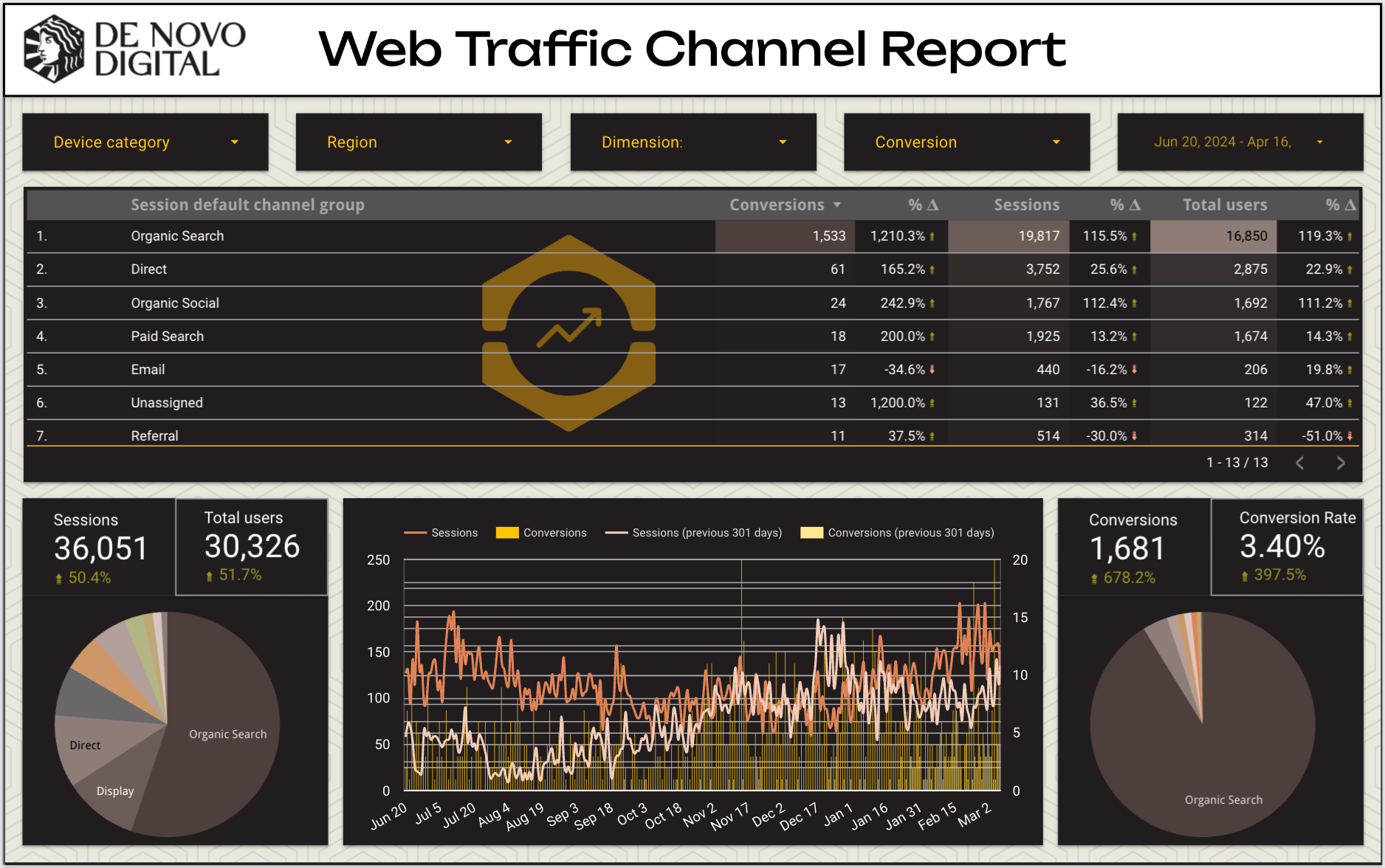
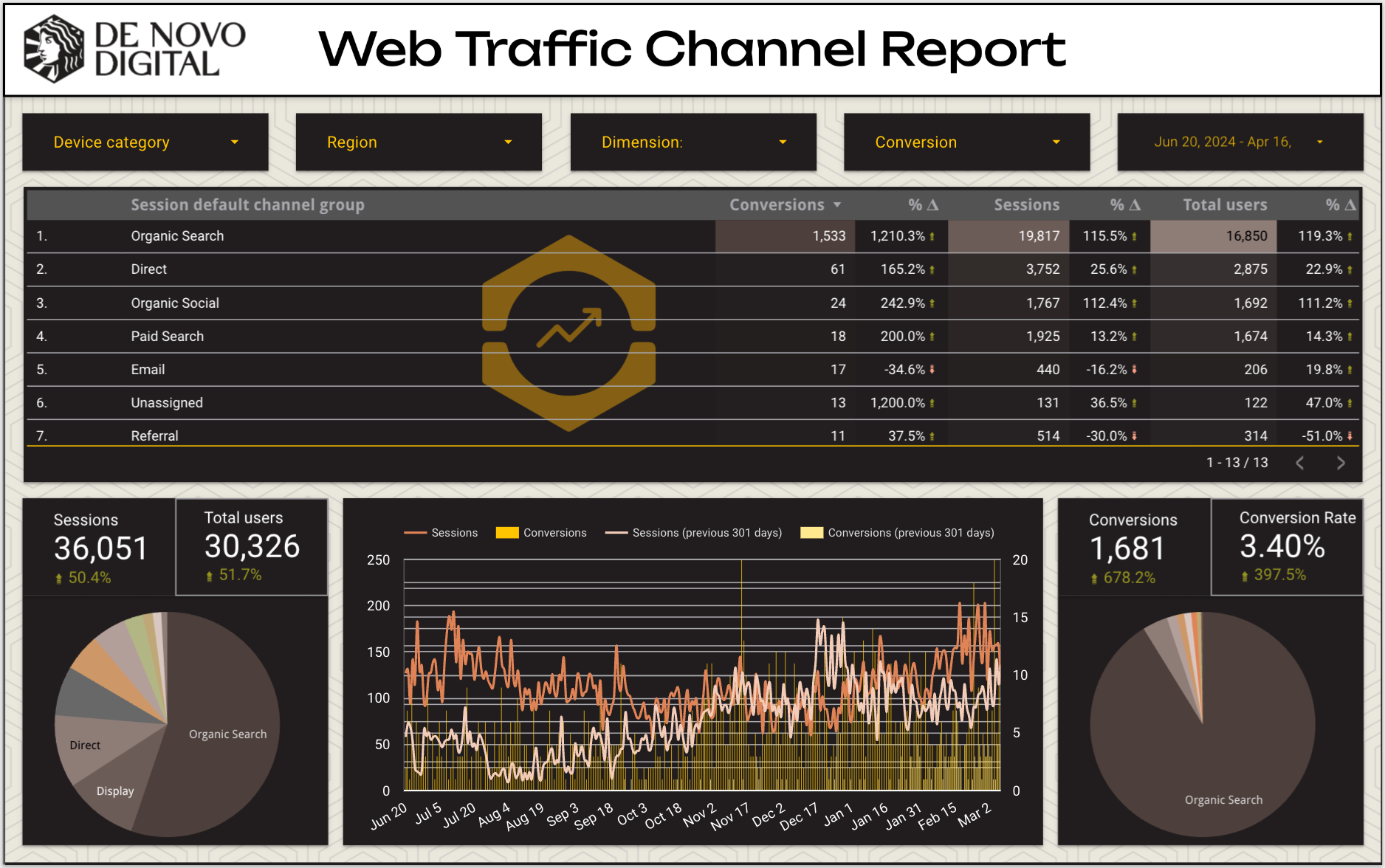 Viewing SEO alongside other channels with a custom dashboard can help connect organic traffic with engagement and conversion data.
Why SEO Dashboards Matter
SEO takes time, which makes measurement especially important. Without clear reporting, it is easy to mistake short-term fluctuations for failure or overlook slow, steady growth that is building real authority.
Most of your metrics mean very little without context. It’s crucial to track organic traffic, keyword rankings, conversions, and other performance signals together, and set achievable milestones based on campaign scope and industry trends.
A good SEO performance dashboard helps teams separate noise from meaningful trends. It also helps leadership understand how organic search contributes to business outcomes.
For example, rankings alone rarely tell the full story. A page may rank higher but fail to convert. Another page may attract fewer visitors but generate more qualified leads. A dashboard helps make those distinctions visible.
SEO Metrics You Should Be Measuring
The right SEO dashboard metrics depend on your goals, but most businesses should track a core set of indicators. SEO measurement should include traffic, rankings, conversions, and backlinks, as well as broader visibility trends.
Organic Traffic
Organic traffic shows how many visitors arrive from unpaid search results. This is one of the most important SEO metrics because it reflects whether your visibility is translating into actual website visits.
However, traffic volume alone is not enough. The quality of that traffic matters just as much. A strong SEO dashboard should show which pages bring in organic visitors and whether those visitors take meaningful actions.
Keyword Rankings
A strong SEO ranking dashboard tracks priority keywords over time. This helps teams understand whether optimization work is improving visibility for the terms that matter most.
A SEO keyword dashboard can also help identify emerging opportunities. If a page is ranking on page two or three for a valuable keyword, it may be a good candidate for content updates, internal links, or technical improvements.
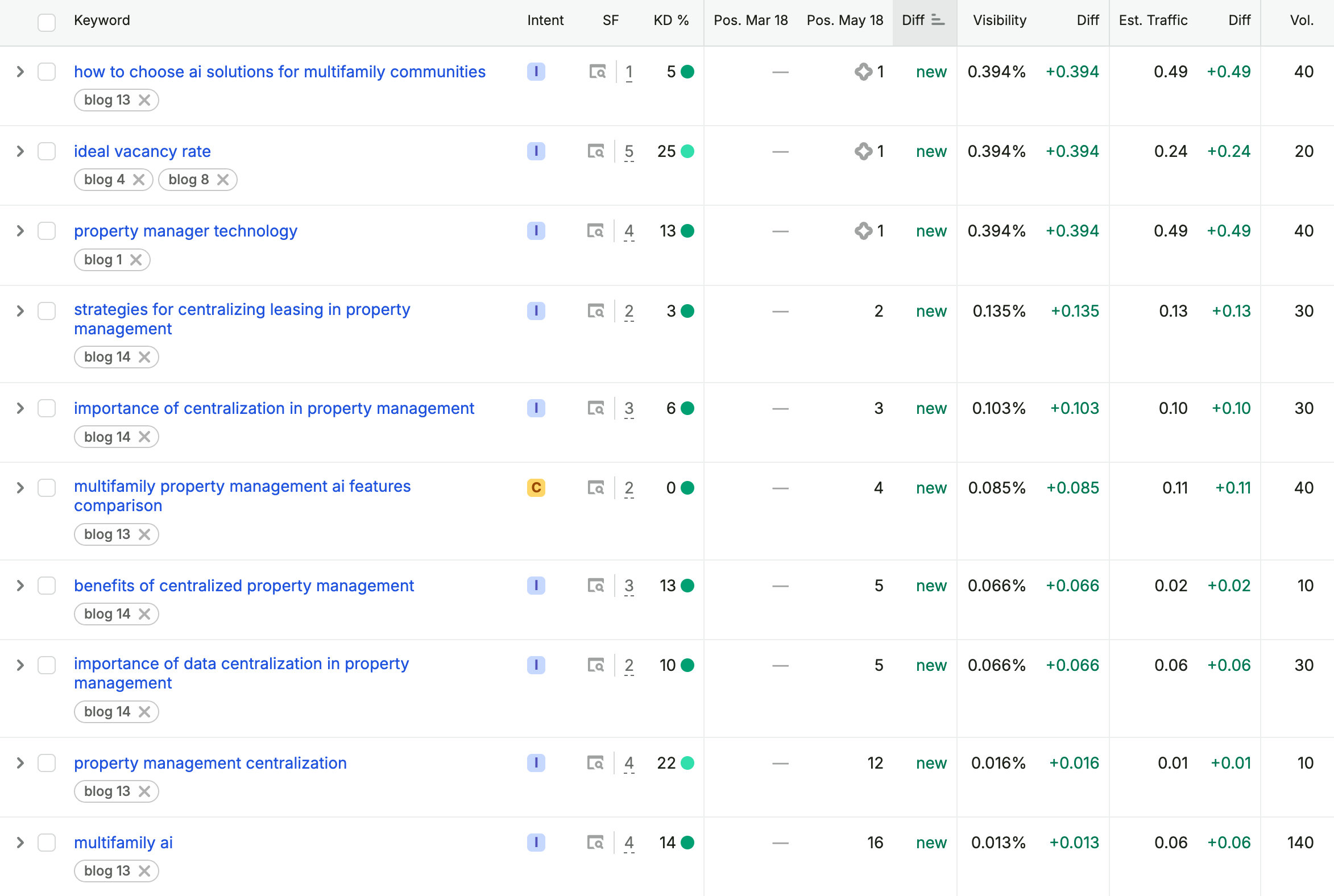 Tagging keywords in Semrush’s Position Tracking report is an easy way to isolate keyword clusters and track their movements over time.
Conversions From Organic Search
SEO success should be measured by more than clicks. Businesses should track how organic visitors convert into leads, customers, form submissions, calls, downloads, or other meaningful actions.
Although privacy and consent regulations such as GDPR and CCPA have made user tracking more complex, GA4's Funnel Exploration can still uncover valuable insights beyond the initial organic click, helping SEO teams make their contribution to business outcomes more visible.
Actionable SEO reporting should connect organic visits to the actions users take later in the journey.
Engagement Metrics
Engagement metrics help show whether organic visitors find your content useful. These may include time on page, engagement rate, scroll depth, pages per session, and return visits.
These metrics are especially helpful when evaluating informational content, industry guides, and service pages that support longer buyer journeys.
Technical SEO Health
A complete SEO analytics dashboard should include technical performance indicators such as crawl errors, indexation issues, page speed, mobile usability, and structured data errors.
These issues may not always be visible to users, but they can significantly affect search visibility. Many businesses uncover them through SEO audit services, then use dashboards to monitor progress over time.
Backlinks and Authority Signals
Backlinks still matter for both local SEO and AI search visibility. Tracking referring domains, link quality, and authority signals can help businesses understand whether their digital presence is becoming more credible over time.
This is especially important for competitive industries where trust and authority strongly influence rankings.
AI Search Visibility
Traditional SEO dashboards are beginning to evolve as search engines incorporate AI-generated answers. Businesses now need to monitor whether their brand appears in AI search responses, answer engines, and conversational search platforms.
New KPI concepts for the generative search era, including AI brand visibility signals that go beyond traditional rankings and clicks, are becoming standard tracking metrics. That means brand mentions, backlinks, and other trust signals are becoming just as important to monitor as organic traffic.
For companies investing in AEO services, AI visibility should increasingly sit alongside traditional SEO performance metrics.
How to Measure SEO in Google Analytics
Many businesses start by asking how to measure SEO performance in Google Analytics. GA4 can provide useful insight into how organic search visitors behave after they arrive on your website.
A Google Analytics SEO dashboard can show:
- organic sessions
- landing pages from organic search
- engagement rates
- conversions from organic users
- assisted conversions
- user paths after organic landing page visits
The most useful GA4 dashboards go beyond traffic. They help answer whether organic visitors are moving through the customer journey in ways that support business goals.
For example, a law firm may want to know whether organic visitors submit consultation forms. A SaaS company may care about demo requests. A nonprofit may track donations, volunteer sign-ups, or newsletter subscriptions.
The right dashboard should reflect the business model.
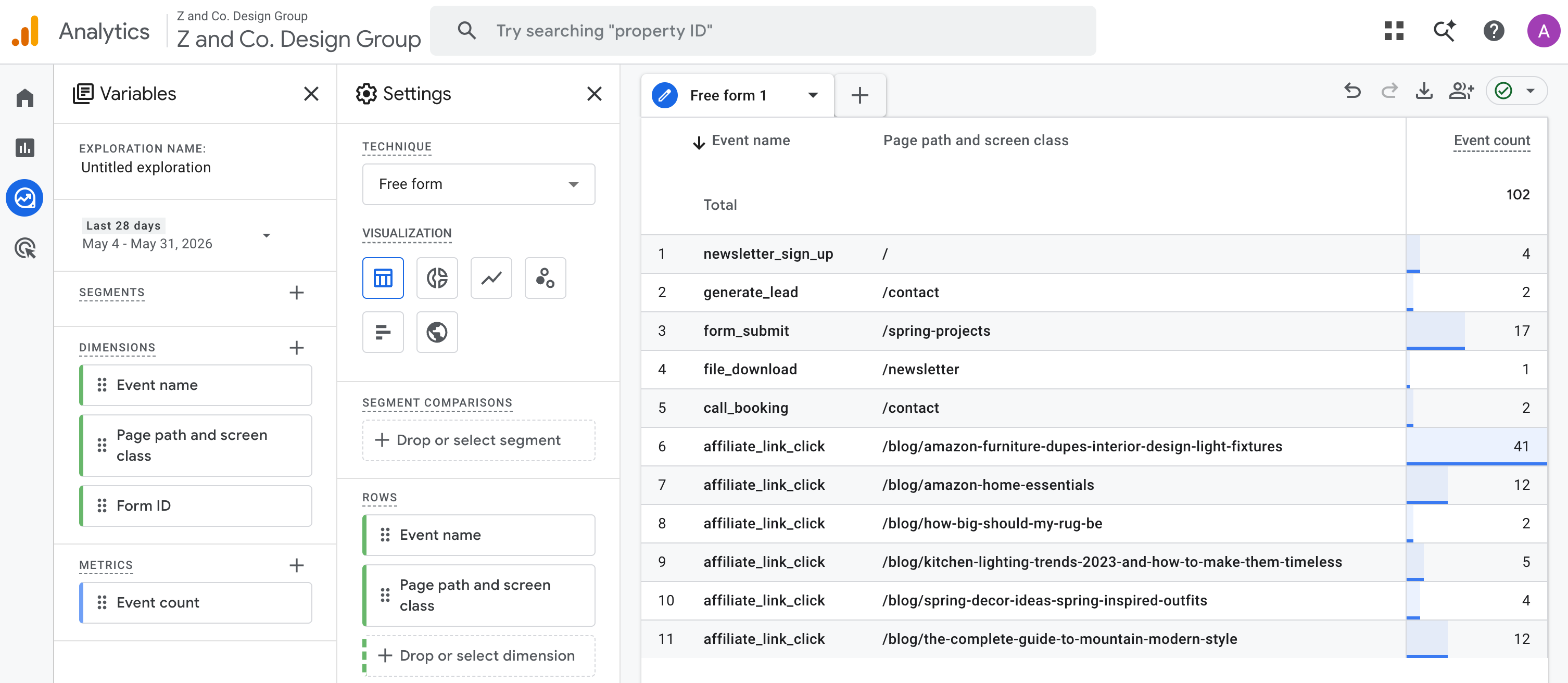 Simple GA4 explorations can provide valuable insights for understanding SEO's value, without the trouble of designing a new custom branded report in Google Data Studio.
How to Measure SEO ROI
One of the most important questions in search marketing is how to measure SEO ROI.
SEO ROI compares the value generated by organic search against the cost of SEO investment. This may include agency fees, content production, technical improvements, link building, analytics setup, and internal team time.
A simple SEO ROI framework looks at:
- cost of SEO investment
- organic leads or conversions
- estimated value of those conversions
- revenue influenced by organic search
- long-term value of improved rankings and visibility
For B2B and enterprise organizations, proving SEO value often requires connecting leading indicators, such as rankings and traffic, with lagging indicators, such as pipeline and revenue. A strong SEO marketing dashboard should help tell that story clearly.
Enterprise SEO reporting is most effective when it connects search performance to the business outcomes stakeholders care about.
How to Create an SEO Dashboard
Building an SEO dashboard starts with identifying the questions your team needs to answer. Too many dashboards fail because they include every available metric instead of focusing on decisions.
A useful dashboard should answer:
- What changed?
- Why did it change?
- What should we do next?
- How does this affect business performance?
To create an SEO dashboard, start with your primary goals. Then choose the metrics that reflect progress toward those goals. Finally, connect data sources such as Google Analytics, Google Search Console, keyword tracking tools, SEO platforms, CRM systems, and call tracking software.
A custom SEO dashboard is often more useful than a generic template because every business has different goals. Local service businesses, SaaS companies, ecommerce brands, and law firms all need different reporting views.
Local SEO Dashboards
A local SEO dashboard should focus on location-based visibility and actions from nearby customers.
Important local SEO metrics may include:
- Google Business Profile views
- calls from local search
- direction requests
- local keyword rankings
- review growth
- map pack visibility
- citation consistency
Local dashboards are especially useful for businesses with multiple locations or service areas. They help teams compare performance across markets and identify where visibility needs improvement.
For small businesses, this type of reporting pairs naturally with local SEO services, reputation management, and Google Business Profile optimization.
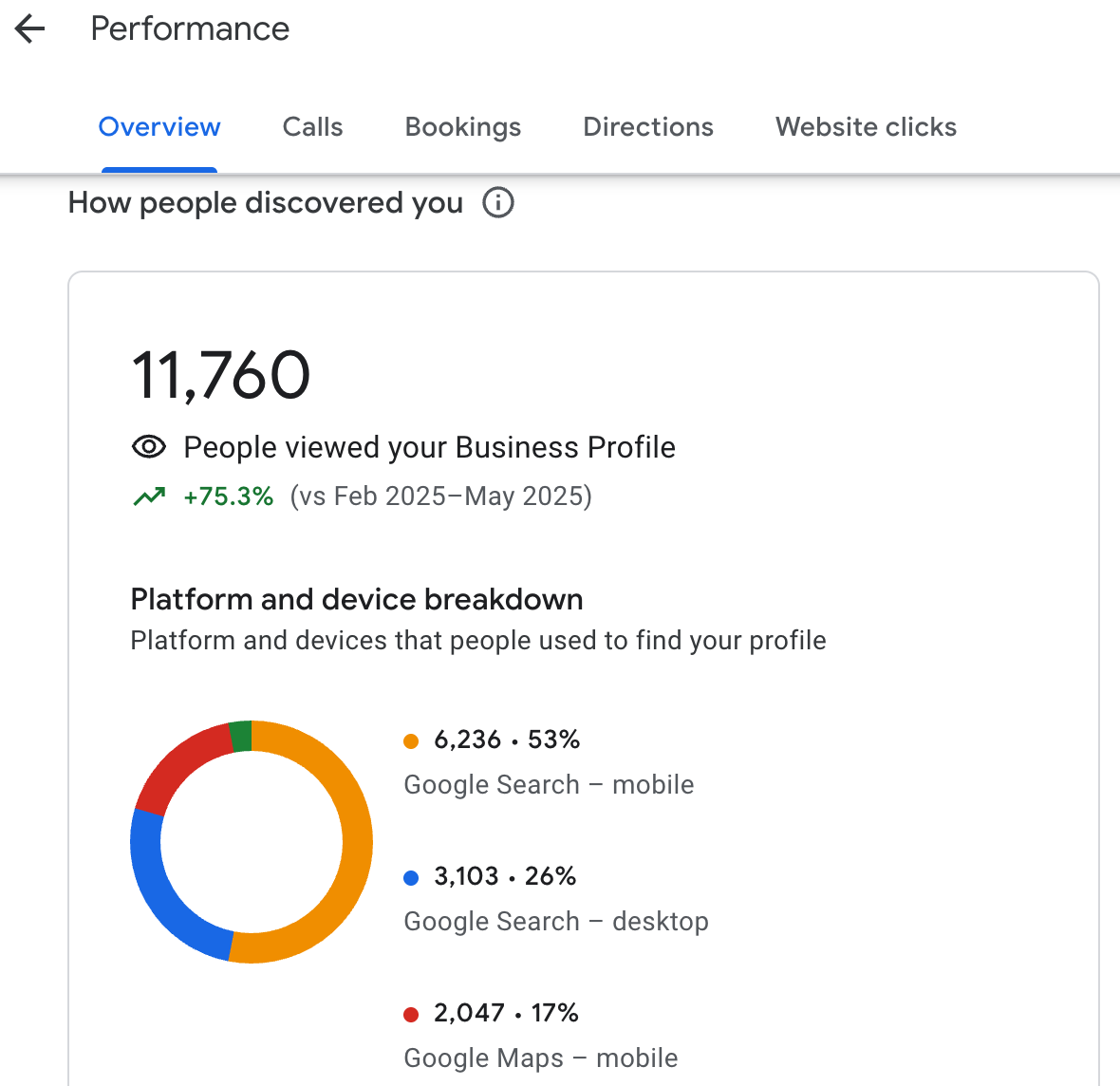 With Google Business Profile's built-in Performance report, you can track map visibility, reviews, calls, and other user activity over time.
Custom SEO Dashboards vs. Template Dashboards
Many tools offer prebuilt SEO reporting dashboards, but templates can only go so far.
A template may be enough for basic reporting, but a customizable SEO dashboard allows businesses to align reporting with their actual goals. That may include custom conversion events, lead quality scoring, CRM attribution, AI visibility tracking, or channel comparisons.
A custom SEO dashboard can also help agencies and internal teams report more clearly to stakeholders. Instead of handing over a generic chart, the dashboard can show exactly how SEO contributes to business outcomes.
This matters because executives rarely care about rankings in isolation. They care about qualified traffic, lead quality, revenue, and growth.
For teams using HubSpot services or other integrated CRMs, SEO dashboards can also connect organic traffic to lifecycle stages, form submissions, deal attribution, and revenue reporting.
SEO Dashboards and AI Search Metrics
Search reporting is changing quickly. Traditional dashboards were built around rankings, clicks, impressions, and sessions. Those metrics still matter, but they no longer tell the entire story.
More marketers are beginning to measure new generative AI search KPIs, highlighting visibility beyond traditional rankings and clicks.
AI search introduces new questions:
- Is your brand appearing in AI-generated answers?
- Which pages are being cited or summarized?
- Are competitors appearing more often in conversational search?
- Do brand mentions correlate with traffic or conversions?
- Are users discovering you without clicking through immediately?
This is where SEO reporting begins to overlap with the best AEO tools, brand visibility tracking, and broader marketing analytics tools.
The best dashboards will increasingly combine SEO metrics, AI visibility signals, CRM data, and conversion tracking into one view.
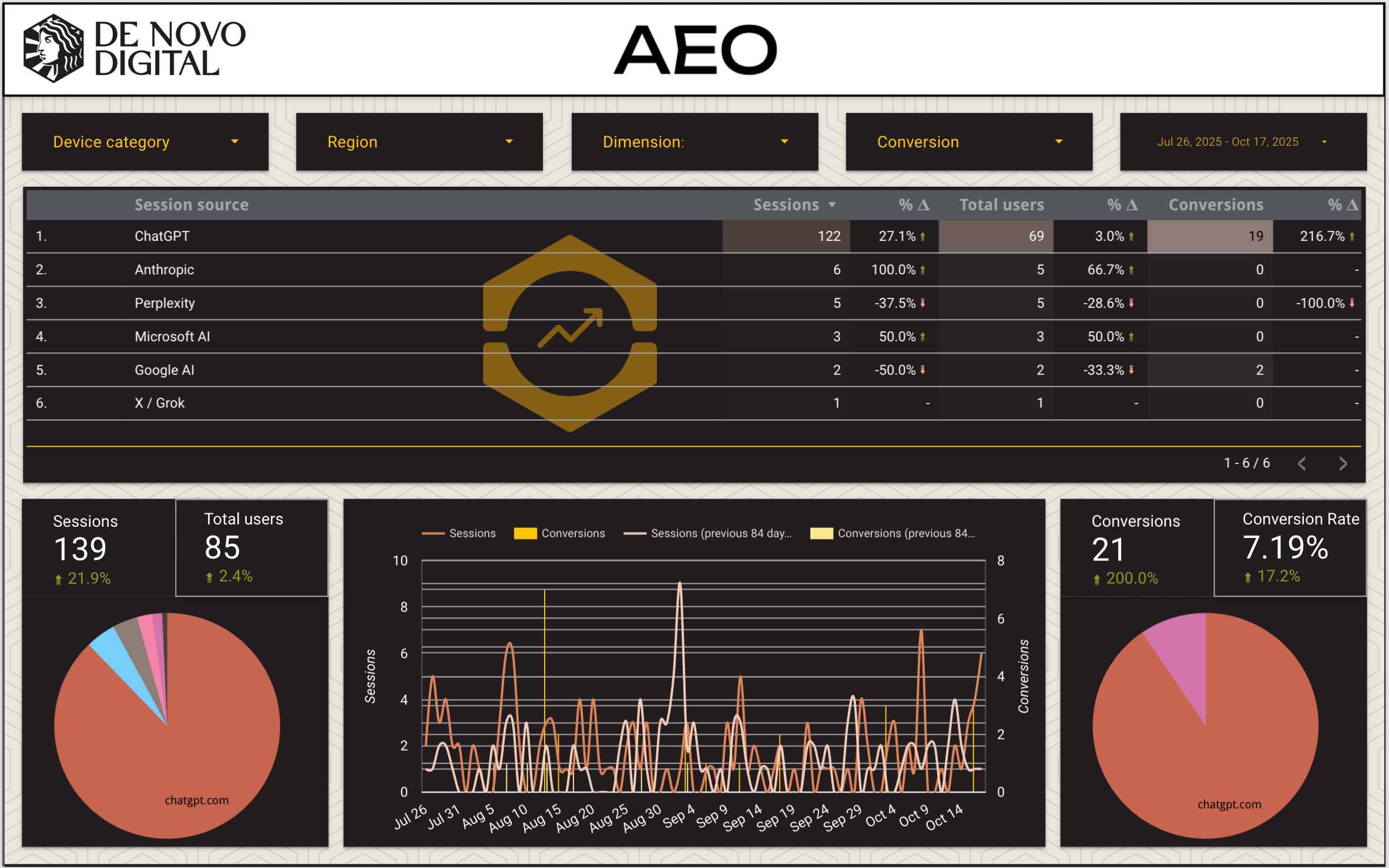 Modern SEO dashboards increasingly incorporate AI channel visibility and answer-engine presence alongside traditional metrics like Sessions and Conversions.
What Makes a Good SEO Client Dashboard?
A good SEO client dashboard should be simple enough to understand quickly and detailed enough to guide strategy.
For agencies, that means avoiding vanity reporting. Clients need to see whether SEO is improving visibility, attracting qualified traffic, and contributing to measurable outcomes.
A strong dashboard should include:
- executive summary metrics
- keyword and visibility trends
- organic traffic quality
- conversion performance
- completed SEO work
- upcoming priorities
- business impact
This is also where white label reporting tools can help agencies scale. A white label SEO dashboard may be useful for reporting consistency, but the strategy behind the dashboard still matters more than the design.
SEO Dashboards Work Best When Strategy Comes First
Tools can organize data, but they cannot decide what matters.
Before building a dashboard, businesses need clarity around their SEO goals. A local business may care most about calls and map visibility. A B2B company may care about demo requests and pipeline influence. A publisher may focus on traffic growth and content engagement.
At De Novo Digital, we build reporting systems that connect SEO performance with broader marketing outcomes. That includes custom SEO dashboards, GA4 reporting, AEO visibility tracking, HubSpot attribution, and all-in-one reporting systems that help teams make better decisions.
Simple dashboards work because they reduce noise. The best dashboards focus on the metrics that help your team act with confidence.
Ready to Build SEO Dashboards That Actually Help?
SEO reporting should make decisions easier. If your dashboards are full of disconnected metrics, it becomes harder to understand what is working and where to focus next.
De Novo Digital helps businesses build custom SEO dashboards that connect rankings, traffic, conversions, AI visibility, and revenue into one clearer reporting system.
If you want to measure SEO performance with confidence, let’s build a dashboard that shows what matters. Connect with us today to get started.