


What law firms need to know about local SEO, AEO, content strategy, and legal search visibility in the AI era
Search has changed. The fundamentals have not disappeared.
For years, SEO for lawyers focused on ranking law firm websites in traditional search results. Firms invested in practice area pages, local SEO, Google Business Profile optimization, backlinks, legal content, technical SEO, and conversion-focused websites to generate more qualified consultations.
Those strategies still matter.
But AI search has changed how potential clients discover, evaluate, and compare law firms. Search platforms increasingly summarize answers, cite sources, surface local businesses, and help users make decisions before they ever click through to a website.
That means law firms need to think beyond rankings alone.
Modern law firm SEO now includes traditional SEO, local SEO, Answer Engine Optimization, reputation signals, structured content, attorney authority, and conversion tracking. The goal is not only to rank. The goal is to be understood, trusted, cited, and chosen across both search engines and AI-driven discovery environments.
In This Post
- What Is SEO for Lawyers?
- How AI Has Changed Law Firm SEO
- What Hasn't Changed About SEO for Lawyers
- Why Local SEO Still Matters for Law Firms
- Google Business Profile and Local SEO for Lawyers
- How Different Practice Areas Should Approach SEO
- SEO, AEO, and AI Visibility for Law Firms
- Content Strategy for Legal SEO in the AI Era
- Technical SEO and Schema for Law Firms
- How to Track SEO Results for Lawyers
- Choosing an SEO Agency for Lawyers
What Is SEO for Lawyers?
SEO for lawyers is the process of improving a law firm’s online visibility so potential clients can find the firm when they search for legal help.
This usually includes:
- practice area page optimization
- local SEO
- Google Business Profile optimization
- legal content strategy
- technical SEO
- backlink building
- online reputation management
- website conversion optimization
- analytics and reporting
Traditional SEO helps law firms appear in search results for queries like “personal injury lawyer near me,” “criminal defense attorney in [city]em>,” “divorce lawyer near me,” or “immigration attorney for work visa.”
But law firm SEO is not only about traffic. It is about qualified visibility.
A family law firm does not need every visitor. It needs the right local clients with the right legal needs. A mass tort firm may need broader national visibility. An employment law firm may need content that addresses both local and industry-specific legal questions.
That is why SEO services for lawyers should be built around practice area, geography, client intent, and intake goals.
How AI Has Changed Law Firm SEO
AI has not replaced SEO. It has changed how SEO works.
Potential clients now use traditional search engines, AI summaries, AI chat platforms, local map results, legal directories, review sites, and law firm websites as part of the same research journey.
A user might ask:
- “What should I do after a car accident?”
- “How much does a DUI lawyer cost?”
- “Can I sue my employer for wrongful termination?”
- “What happens during a divorce consultation?”
- “Do I need an immigration lawyer for a green card?”
- “Who are the best bankruptcy lawyers near me?”
In traditional search, the user might scroll through links. In AI search, the platform may generate an answer, summarize common legal considerations, mention law firms, cite legal resources, or push the user toward additional research.
That creates a new visibility challenge.
Law firms need content that is:
- accurate
- well-structured
- locally relevant
- written in plain language
- supported by attorney expertise
- easy for search engines and AI systems to interpret
- connected to clear next steps
AI search rewards clarity. It also raises the stakes for trust.
What Hasn’t Changed About SEO for Lawyers
Even with AI, the strongest law firm SEO strategies still depend on fundamentals.
Search engines and AI systems both need clear signals that a firm is credible, relevant, and useful. That means the basics still matter:
- strong practice area pages
- clear attorney bios
- local relevance
- accurate business information
- helpful legal content
- strong reviews
- technical website health
- high-quality backlinks
- fast page performance
- mobile-friendly design
- clear conversion paths
AI did not make these signals obsolete. It made them more important.
A strong strategy still depends on a credible website, which is why law firm web design remains part of SEO performance.
If your website is thin, outdated, confusing, or technically weak, AI search will not magically solve the problem. If your local listings are inconsistent, your reviews are weak, and your practice area pages are generic, your firm will struggle in both traditional and AI-driven search.
An integrated law firm website builder can help firms connect site architecture, practice area pages, intake workflows, analytics, and conversion paths into one foundation for SEO and AI search visibility.
The firms most likely to benefit from answer engine visibility are often the same firms already investing in strong SEO foundations.
SEO for Lawyers
What Changed vs. What Hasn't
How AI has shifted the rules — and what still drives results
| What |
| Changed |
| What Hasn't |
| Changed |
DE NOVO DIGITALdenovodigital.com
Why Local SEO Still Matters for Law Firms
Most legal searches are local.
Even when someone asks a broad legal question, they often need help from an attorney licensed in their state or located near their city. That makes local SEO for lawyers one of the most important parts of a law firm’s digital marketing strategy.
Local SEO helps law firms appear for location-based searches such as:
- “criminal defense lawyer near me”
- “divorce lawyer in Phoenix”
- “personal injury attorney Los Angeles”
Local SEO services for lawyers typically include:
- Google Business Profile optimization
- local landing pages
- local citations
- review strategy
- local backlinks
- practice area and city page structure
- localized content
- map pack visibility tracking
This matters because potential clients often want reassurance that a firm understands their local courts, state laws, judges, procedures, and community context.
AI search may change the interface, but local relevance still matters.
Google Business Profile and Local SEO for Lawyers
Google Business Profile remains one of the most important assets for local SEO for lawyers.
A strong profile can help a law firm appear in map results, local searches, branded searches, and discovery searches. It also gives potential clients immediate access to reviews, contact information, office location, hours, photos, services, and website links.
For law firms, Google Business Profile optimization should include:
- accurate firm name, address, and phone number
- correct primary and secondary categories
- service areas where appropriate
- practice area services
- consistent office information
- regular updates
- thoughtful review responses
- accurate links to relevant pages
- high-quality photos where appropriate
Firms should also have a strong review acquisition strategy, because improving Google reviews is closely tied to local visibility and trust.
Google Business Profile does not replace the website. It supports it.
The strongest local SEO strategies connect GBP, local landing pages, attorney bios, reviews, citations, backlinks, and conversion-focused website design into one system.
Beyond Google, local AEO searches largely rely on things other people on the internet are saying about your brand, such as Reddit forums, directories, rating sites, and syndicated blog posts on high-authority domains.
The way people talk about your brand is more important than ever – this is what makes online reputation management such a big part of local SEO and AEO campaigns.
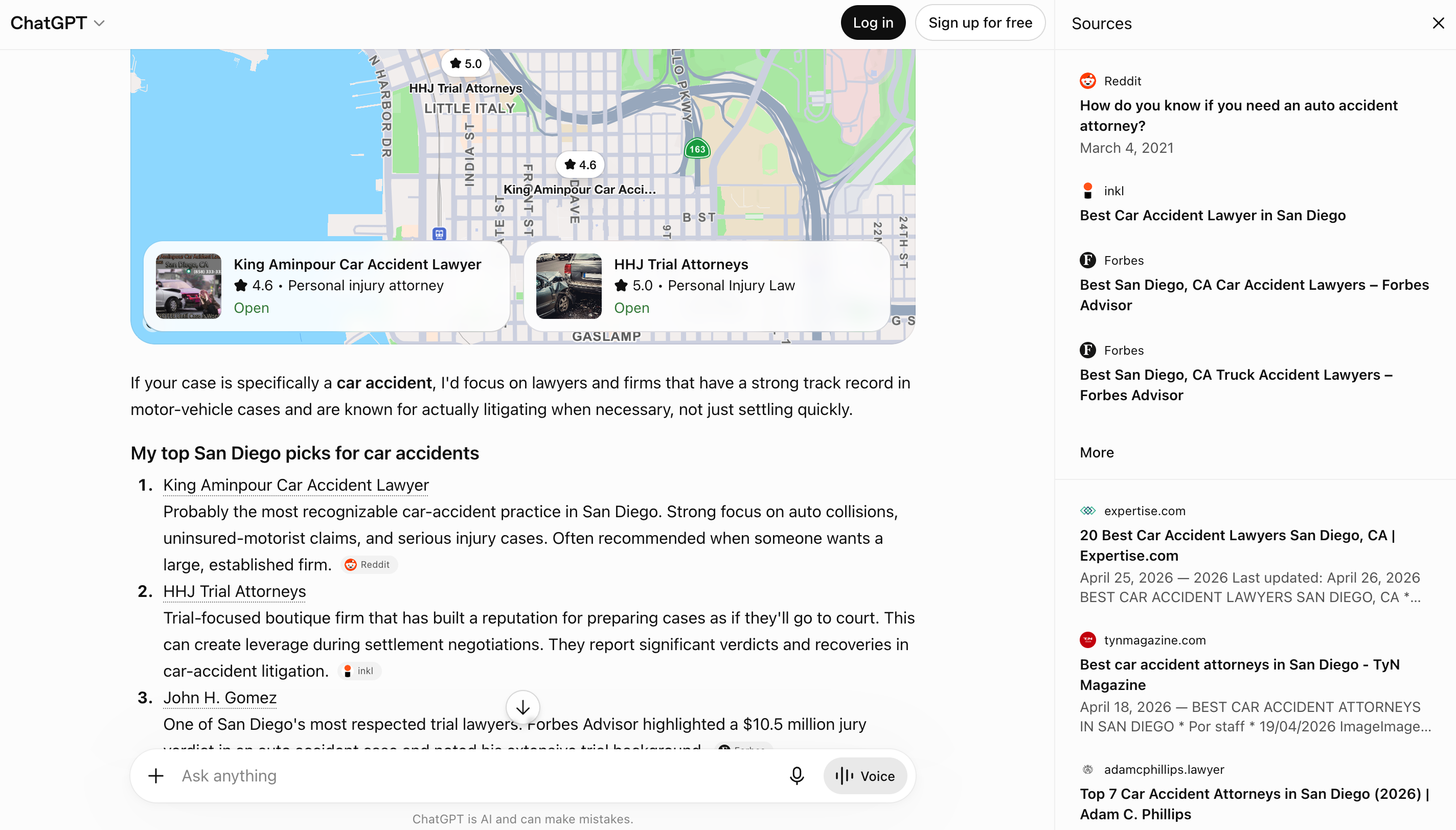 Look familiar? Local AI Search results look a lot like Google Map Packs, but rankings depend much more on what others say about you – not just the content on your website.
How Different Practice Areas Should Approach SEO
Not every law firm should approach SEO the same way. Practice area, case value, competition, geography, urgency, and client behavior all influence strategy.
Firms competing in high-value injury markets may need a more specialized strategy.
SEO for Personal Injury Lawyers
With high case values and strong search demand, personal injury lawyer SEO is often highly competitive.
A strong SEO strategy for personal injury lawyers should include:
-
-
- detailed injury-specific practice pages
- local accident and injury content
- attorney authority signals
- case results where ethically permitted
- strong review strategy
- fast mobile performance
- clear consultation CTAs
- local backlinks
- content for common client questions
- detailed injury-specific practice pages
-
Personal injury SEO should also account for urgency. Potential clients may be searching shortly after an accident, so the website must be clear, fast, trustworthy, and easy to contact.
SEO for Mass Tort Lawyers
SEO for mass tort lawyers often requires a broader strategy than local-only SEO.
Mass tort marketing may target users across multiple states or nationally, depending on the campaign. These firms often need content that explains emerging litigation, eligibility, deadlines, injuries, manufacturers, products, and case updates.
Strong mass tort SEO should include:
-
-
- condition or product-specific landing pages
- content that explains eligibility clearly
- structured intake pathways
- compliant, accurate legal information
- campaign-specific tracking
- authority-building content
- paid media and SEO alignment
- strong conversion tracking
- condition or product-specific landing pages
-
For mass tort firms, SEO often works best when connected to a broader lead generation strategy.
For national campaigns, SEO often works best when connected to a tailored mass tort marketing and intake workflow.
SEO for Criminal Defense Lawyers
SEO for criminal defense lawyers should focus on urgency, local trust, and clear explanations of legal process.
Potential clients may search late at night, on mobile devices, or under stress. They need quick reassurance, plain-language guidance, and a clear way to contact the firm.
Important content topics may include:
-
-
- DUI defense
- drug charges
- assault charges
- domestic violence defense
- theft charges
- probation violations
- first-time offenses
- felony vs. misdemeanor charges
- what happens after an arrest
- DUI defense
-
Local SEO for criminal lawyers should also focus on city-specific visibility, Google Business Profile strength, reviews, and mobile conversion paths.
SEO for Family and Divorce Lawyers
SEO for family lawyers and divorce lawyers depends heavily on trust.
Potential clients are often dealing with emotionally difficult situations involving children, finances, property, custody, or domestic conflict. The content should be clear, calm, and reassuring.
SEO for divorce lawyers should include:
-
-
- divorce process pages
- child custody content
- property division content
- spousal support content
- local divorce procedure pages
- attorney bios that build trust
- FAQ-style content
- reviews and reputation signals
- clear consultation pathways
- divorce process pages
-
Local SEO for divorce lawyers is especially important because family law is usually tied to state and county procedures.
SEO for Immigration Lawyers
SEO for immigration lawyers often requires both local and national content strategy.
Potential clients may search by visa type, immigration status, family situation, employer sponsorship, or urgent legal concern.
Strong immigration SEO may include content around:
-
-
- green cards
- work visas
- citizenship
- deportation defense
- asylum
- employer immigration support
- green cards
-
Because immigration topics can be complex, AI search may summarize answers heavily. That makes clear structure, attorney expertise, and accurate content especially important.
SEO for Employment Lawyers
SEO for employment lawyers should address both employee-side and employer-side intent, depending on the firm’s services.
Potential topics may include:
-
-
- wrongful termination
- discrimination
- harassment
- retaliation
- unpaid wages
- severance agreements
- workplace accommodations
- whistleblower claims
- employment contracts
- wrongful termination
-
Employment law content must be precise and jurisdiction-aware. AI search visibility depends on content that clearly explains who the firm helps, what legal issue is involved, and where the firm practices.
SEO for Bankruptcy Lawyers
SEO for bankruptcy lawyers often involves users who are overwhelmed, stressed, and looking for practical answers.
Content should clearly explain:
-
-
- debt relief options
- foreclosure concerns
- wage garnishment
- medical debt
- bankruptcy eligibility
- what happens after filing
- debt relief options
-
The best bankruptcy SEO strategies combine local search visibility with approachable educational content and clear consultation pathways.
SEO, AEO, and AI Visibility for Law Firms
SEO helps law firms become visible in search engines.
AEO helps law firms become understandable and useful in answer-driven search experiences, and it’s changing how consumers evaluate firms.
For law firms, AEO means structuring content so AI systems can more easily interpret, summarize, cite, and connect the firm to relevant legal topics.
This may include:
- question-based headings
- concise answers under each heading
- attorney-authored content
- schema markup
- local entity signals
- clear practice area structure
- FAQ content
- updated legal information
- external citations where appropriate
- consistent firm information across the web
Remember that AEO does not replace SEO. It extends it.
Law firms still need strong website architecture, crawlable pages, local optimization, backlinks, reviews, and technical performance. But those assets now need to support both search results and AI-generated answers.
This is where AEO for law firms extends traditional SEO by making legal content easier for AI systems to interpret, summarize, and cite.
Content Strategy for Legal SEO in the AI Era
Legal content has always needed to be useful. AI search makes usefulness easier to reward and harder to fake.
The best law firm content answers real client questions clearly and accurately. It does not rely on vague legal summaries, keyword stuffing, or generic practice area pages that sound like every other firm.
Strong content marketing campaigns help firms build topical authority by turning real client questions, practice area expertise, and attorney insight into useful resources that support both SEO and AEO.
A strong legal content strategy should include:
- detailed practice area pages
- local service pages
- attorney bios
- FAQs
- process explainers
- comparison content
- case-type guides
- glossary-style definitions
- blog posts answering real intake questions
- content for different stages of the client journey
When you optimize your law firm’s content for AI search, structure matters. Question and answer formats are nice, but clear explanations are essential. Like with traditional SEO, headings should be descriptive – it’s usually best to deliver the main idea right away.
This helps both human readers and AI systems understand the content.
Law Firm SEO
The SEO + AEO Visibility System
Ten inputs that drive qualified legal leads
Technical SEO and Schema for Law Firms
Technical SEO is still essential for lawyers.
A law firm website should be fast, secure, mobile-friendly, crawlable, and easy for search engines to understand. Technical issues can limit visibility even when the content is strong.
Important technical SEO elements include:
- clean site architecture
- fast page speed
- mobile responsiveness
- internal linking
- XML sitemaps
- optimized title tags and meta descriptions
- canonical tags
- crawlability
- indexation management
- structured data
- accessible page design
Schema markup is especially important as search becomes more AI-driven.
Law firms should consider schema for:
- Organization
- LocalBusiness
- LegalService
- Attorney
- Article
- FAQPage
- Review, where appropriate and compliant
Schema helps search systems understand what a page represents. It can clarify that a page is a legal service page, an attorney bio, a law firm office location, or a legal article.
For firms competing in AI search, structured data should not be treated as an afterthought. A detailed SEO audit can uncover crawl, schema, page speed, and local visibility issues.
How to Track SEO Results for Lawyers
Tracking SEO results for lawyers requires more than keyword rankings.
Rankings and traffic are useful, but they do not show whether SEO is generating qualified consultations, signed cases, or revenue.
Law firms should track:
- organic traffic
- local rankings
- map pack visibility
- Google Business Profile actions
- form submissions
- phone calls
- consultation requests
- chat inquiries
- lead quality
- signed cases
- cost per qualified lead
- practice area performance
- conversion rate by landing page
- AI visibility and brand mentions
- assisted conversions
This is especially important because AI search may influence users before they click. A potential client might see the firm mentioned in an AI answer, search the firm name later, read reviews, and then contact the firm directly.
Tracking AI search metrics can help law firms understand whether their brand is appearing in AI-generated answers, how often their content is cited, and whether AI visibility is influencing branded search, direct traffic, or qualified consultations.
Traditional analytics may not capture that full journey.
Law firms should use SEO dashboards, call tracking, CRM data, Google Business Profile insights, GA4, Search Console, and intake data to understand performance more clearly.
The best SEO company for lawyers should be able to explain not only where rankings improved, but how visibility connects to qualified leads and business outcomes.
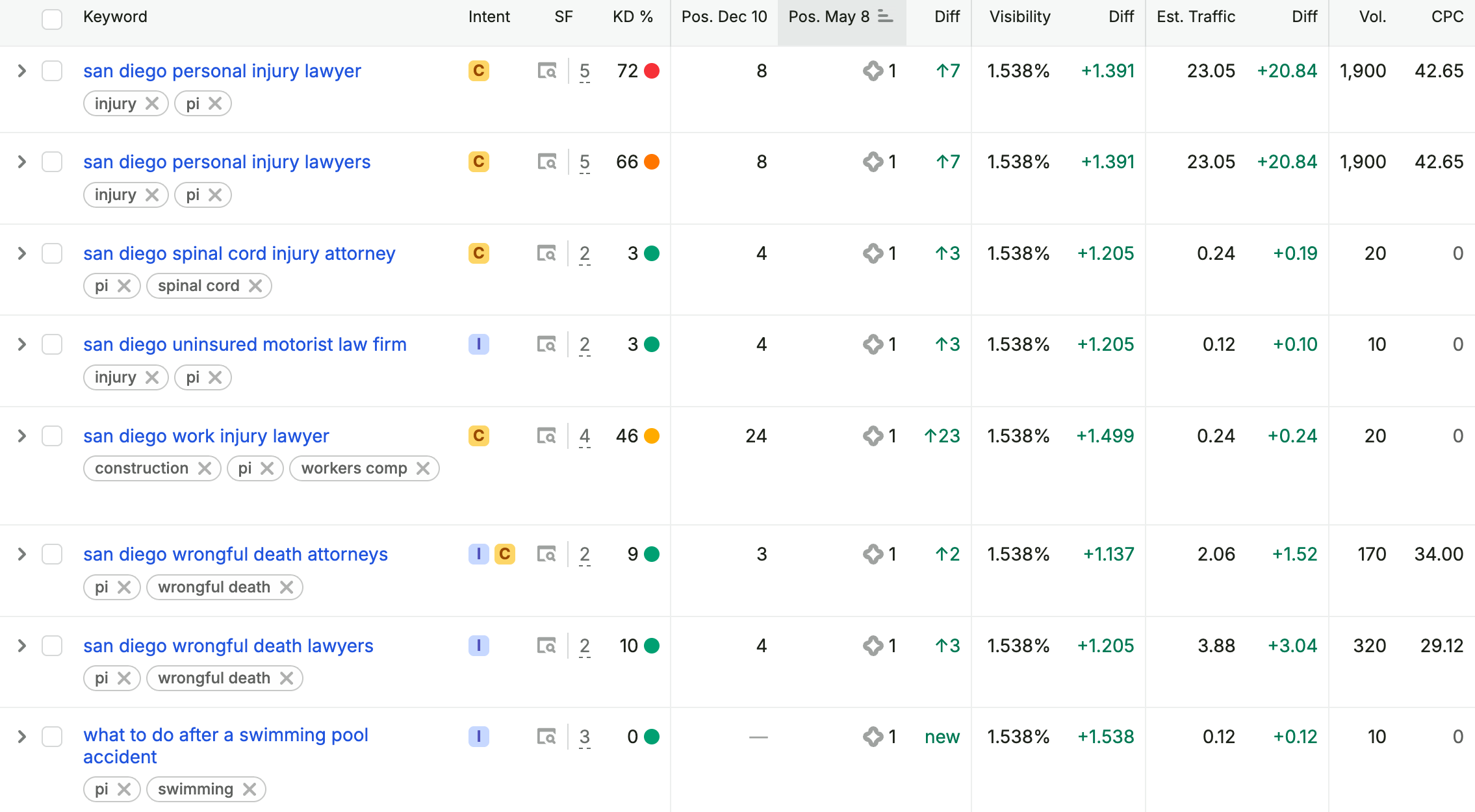 A comprehensive SEO and AEO campaign can help law firms rank on AI search results, raising the topical authority of the entire domain everywhere users are looking.
Choosing an SEO Agency for Lawyers
Many firms search for the best SEO company for lawyers, top SEO company for lawyers, or SEO agency for lawyers because legal marketing is competitive and specialized.
The right partner should understand more than general SEO.
A strong law firm SEO agency should understand:
- legal ethics and advertising considerations
- local SEO for lawyers
- practice area keyword strategy
- Google Business Profile optimization
- attorney authority signals
- schema and technical SEO
- conversion tracking
- intake and CRM workflows
- AI search and AEO
The best SEO companies for lawyers do not simply promise rankings. They build systems that connect visibility to qualified leads.
When evaluating SEO companies for lawyers, ask:
- How do you measure qualified leads?
- How do you track phone calls and form submissions?
- How do you structure practice area pages?
- How do you use attorney expertise in content?
- How do you report ROI?
- How do you coordinate SEO with paid media, content, and web design?
The answer should be specific. If every law firm receives the same SEO strategy, the strategy is probably not strong enough.
Building a Law Firm SEO Strategy That Lasts
SEO for lawyers has changed with AI, but the core objective remains the same: help the right people find the right legal help at the right moment.
The difference is that visibility now happens across more surfaces.
Law firms need to appear in traditional search results, local map results, AI-generated answers, review ecosystems, legal directories, branded searches, and practice area content.
That requires a connected strategy.
SEO is no longer just about being found. It is about being understood, trusted, and chosen.
At De Novo Digital, we help law firms build SEO and AEO strategies that connect search visibility, local authority, content, analytics, and conversion into one growth-focused system.
If your firm is ready to improve organic visibility, strengthen AI search presence, and turn more qualified searches into consultations, we can help you build the strategy.
Connect with us today to learn more about what our SEO services can do for your law firm.