


The platforms that help marketers measure performance, prove ROI, and improve campaign strategy
Modern marketing generates more data than almost any other business function.
Every website visit, email click, form submission, ad interaction, search query, content download, and CRM update creates a signal about how people engage with your brand.
But the real value comes from turning that data into clearer decisions. That's why using the right analytics tools is so essential.
Marketing analytics tools help organizations measure digital marketing campaigns, identify opportunities for improvement, connect dollars to conversions, and understand which channels contribute to business growth.
But the best tools help teams understand what to do next.
What Marketing Analytics Tools Actually Do
Marketing analytics tools help teams understand how campaigns perform across channels.
Instead of looking at isolated metrics, these platforms combine data from websites, email platforms, advertising networks, CRM systems, social channels, search platforms, and sales tools to provide a complete view of performance.
Marketing analytics tools can help teams:
- track website performance and user behavior
- measure campaign engagement across channels
- connect marketing activities to conversions and revenue
- identify trends in customer behavior
- visualize performance data through dashboards
- compare channel performance
- monitor content marketing performance
- measure lead quality
- evaluate campaign ROI
- improve budget allocation
When used effectively, these insights help marketers refine strategy and make better decisions with more confidence.
Best Marketing Analytics Tools for Businesses
There are many analytics tools for marketing teams, but most businesses need a stack that covers a few core needs: website analytics, campaign reporting, CRM attribution, dashboard visualization, content performance, and decision support.
Here are some of the top marketing analytics tools businesses should know.
Google Analytics
Google Analytics remains one of the most widely used digital marketing analytics tools for measuring website performance.
It helps marketers understand how users arrive on a site, which pages they visit, how they engage, and which actions they take before converting.
Google Analytics can help teams evaluate:
-
-
- website traffic trends
- traffic sources
- user engagement
- conversion events
- landing page performance
- campaign attribution
- content performance
- conversion paths
- website traffic trends
-
For businesses trying to measure the impact of SEO, paid media, email, social, and referral traffic, Google Analytics is often one of the first tools in the analytics stack.
It is especially useful when paired with Google Tag Manager, Google Search Console, Google Ads, CRM data, and custom dashboards.
HubSpot Marketing Hub
HubSpot combines marketing automation, CRM functionality, campaign tools, and analytics in one platform. That makes it especially useful for teams that want to connect marketing activity to the full customer journey.
HubSpot’s analytics tools help marketers evaluate campaign performance across channels, including email marketing analytics, website content, and social media, connecting marketing activities directly to sales outcomes.
HubSpot helps marketers evaluate performance across:
-
-
- email campaigns
- forms
- landing pages
- website activity
- lead source data
- contact behavior
- lifecycle stages
- workflows
- sales activity
- deal attribution
- email campaigns
-
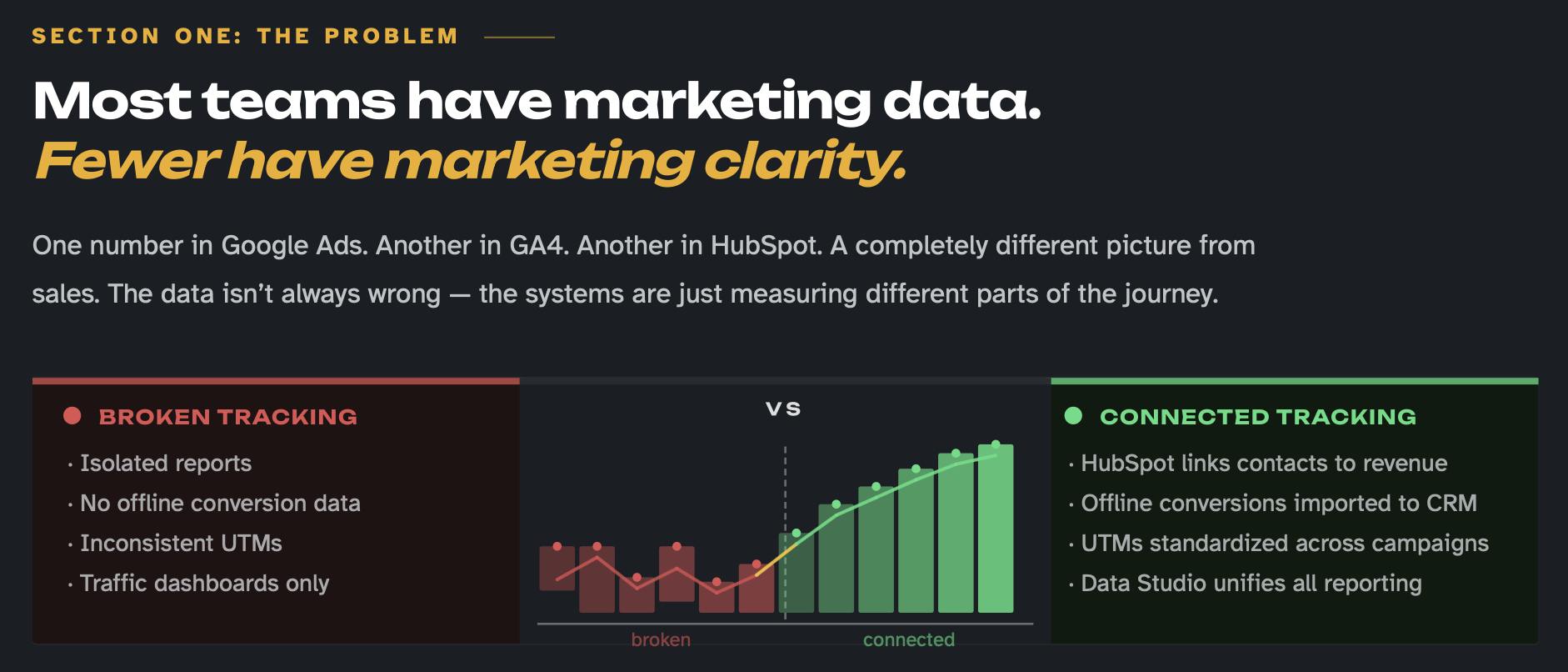
HubSpot’s biggest advantage is that it connects marketing actions to contact records, pipeline, and revenue – HubSpot conversion tracking can help connect form submissions, lifecycle stages, Google Ads, offline conversions, and revenue reporting.
A website analytics tool may show that a user converted. HubSpot can help show what happened after that conversion.
That makes it valuable for businesses that need to understand lead quality, sales handoff, lifecycle progression, and campaign influence.
Free Guide
The HubSpot Conversion Tracking Blueprint
Learn how to measure leads, campaigns, attribution, and ROI across every marketing channel — with HubSpot as your central source of truth. Covers GTM, GA4, Google Ads, Data Studio, lifecycle stages, and dashboard clarity.
Google Data Studio
Google Data Studio is a reporting and dashboard tool that helps marketers visualize data from multiple sources.
It is especially useful for teams that want custom dashboards without building a full enterprise analytics system.
Data Studio can help teams combine data from:
-
-
- Google Analytics
- Google Ads
- Search Console
- spreadsheets
- CRM exports
- paid media platforms
- SEO tools
- third-party connectors
- Google Analytics
-
For businesses that need accessible reporting, Data Studio can turn raw data into clearer dashboards for leadership, marketing teams, and clients.
It works well when teams want to compare marketing channels side by side, track KPIs over time, or build recurring reports that update automatically.
Tableau
Tableau is a data visualization platform built for deeper analysis across large datasets.
Rather than replacing marketing platforms, Tableau often sits above them as a visualization and business intelligence layer.
Marketing teams may use Tableau to:
-
-
- combine complex data sources
- build interactive dashboards
- analyze customer behavior
- visualize trends
- compare campaign performance
- support executive reporting
- uncover patterns across large datasets
- combine complex data sources
-
Tableau is often a better fit for larger organizations or teams with more advanced data needs.
For marketers with multiple business units, long sales cycles, or complex customer journeys, Tableau can help translate large volumes of marketing data into clearer insight.
Adobe Analytics
Adobe Analytics is an advanced enterprise analytics platform for organizations that need deeper insight into customer behavior across digital touchpoints.
It is often used by larger companies with complex digital ecosystems, multiple audience segments, and sophisticated reporting needs.
Adobe Analytics can support:
-
-
- customer journey analysis
- advanced segmentation
- predictive modeling
- cross-channel reporting
- enterprise data governance
- detailed behavioral analysis
- personalized experience measurement
- customer journey analysis
-
Adobe’s own marketing analytics guidance frames analytics as a way to understand customer journeys, evaluate performance, and improve business decisions across channels.
For enterprise teams, Adobe Analytics can be a powerful option, especially when connected to a broader Adobe Experience Cloud environment.
Semrush
Semrush is best known as an SEO platform, but it also functions as a useful marketing analytics tool for teams focused on organic visibility, content performance, competitive research, and paid search insights.
Semrush can help marketers analyze:
-
-
- keyword visibility
- competitor traffic trends
- backlinks
- paid search activity
- content gaps
- topic opportunities
- site health
- search performance
- keyword visibility
-
For teams investing heavily in content marketing, SEO, and AEO, Semrush can help connect search visibility to broader marketing strategy.
Bing Webmaster Tools
Bing Webmaster Tools has become more important as AI search visibility becomes part of marketing analytics.
In addition to traditional search performance reporting, Bing has expanded its AI visibility reporting with features that help publishers understand how their content appears in AI-generated answers across Microsoft Copilot, Bing, and select partner AI experiences.
Its AI Visibility Insights include features such as Intents, Topics, Citation Share, and Compare. Citation Share is especially useful because it shows how much of the citation space a site receives for a specific grounding query, rather than only showing whether the site was cited.
For marketing teams tracking AI search visibility, Bing Webmaster Tools can help answer questions like:
-
-
- Which topics are driving AI citation activity?
- What kinds of intents are associated with cited content?
- How is citation visibility changing over time?
- Which content areas may be gaining or losing AI visibility?
- Which topics are driving AI citation activity?
-
This makes Bing Webmaster Tools a useful addition to a modern marketing analytics stack, especially for teams monitoring SEO, AEO, and overall content performance.
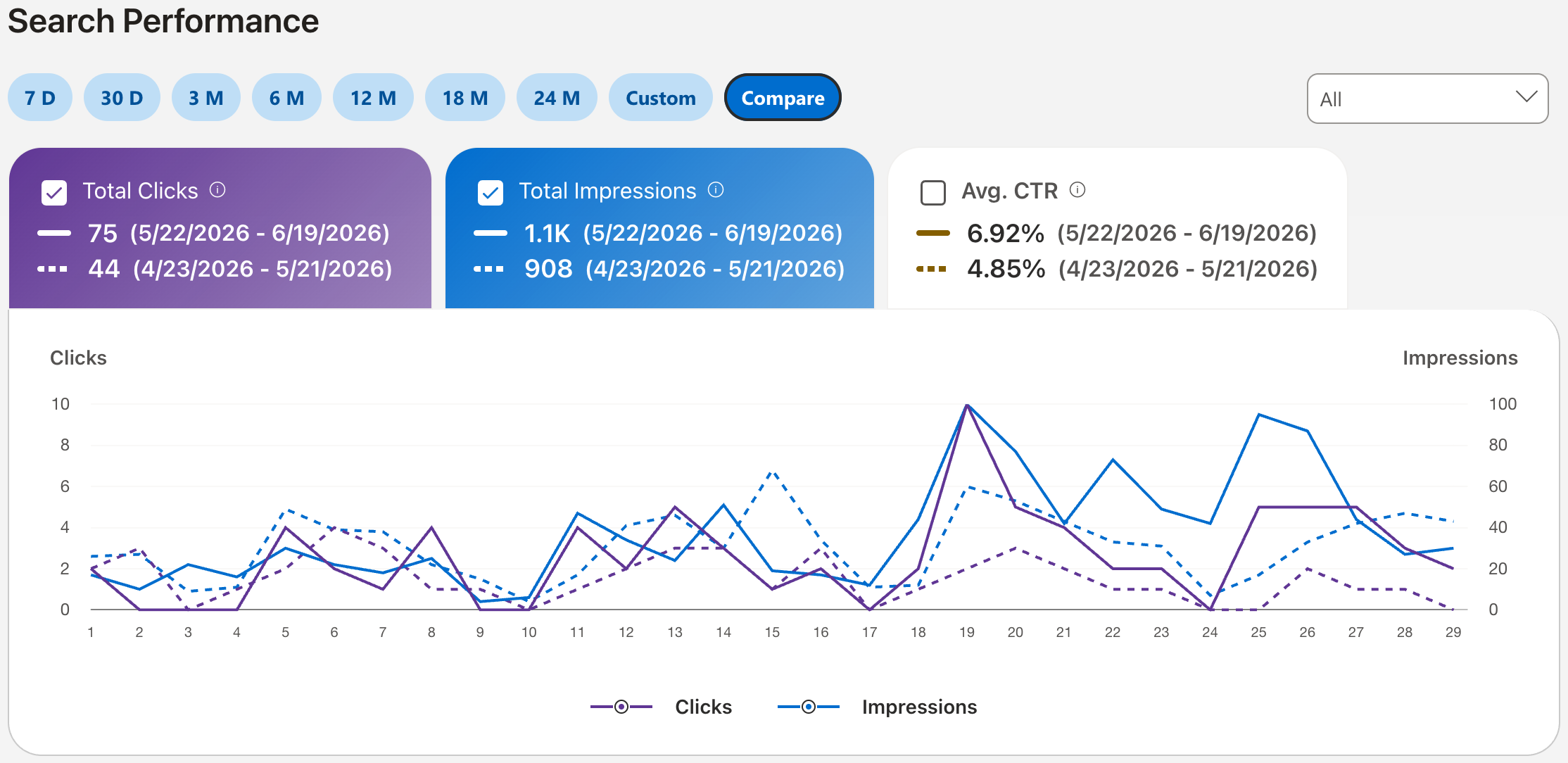 Bing Webmaster Tools is a great free offering for tracking search metrics, and its AI Visibility Insights and Citation Share features make it impossible to ignore.
Content Marketing Analytics Tools
Content marketing analytics tools help teams understand which articles, landing pages, guides, videos, and resources are actually contributing to business outcomes.
Strong content analytics should help answer:
- Which content attracts qualified traffic?
- Which pages generate conversions?
- Which articles support assisted conversions?
- Which topics build authority?
- Which content should be updated, consolidated, or removed?
- Which pages support AI search visibility?
- Which resources help users move closer to a decision?
Content performance can be measured through tools like Google Analytics, Search Console, HubSpot, Semrush, Ahrefs, Looker Studio, and custom dashboards.
The important part is not the tool alone. It is the reporting structure.
A content marketing analytics tool is most valuable when it connects AI search metrics like visibility, engagement, conversion, and revenue influence. This helps teams track whether articles are being surfaced, cited, or mentioned in answer-driven search environments.
AI Marketing Analytics Tools
AI marketing analytics tools are becoming more important as teams try to interpret larger datasets faster. Following the lead of Bing Webmaster Tools, many other first-party platforms are also starting to add AI visibility reporting.
AI tools for marketing analytics can help teams:
- summarize campaign performance
- detect anomalies
- identify trends
- predict customer behavior
- forecast campaign outcomes
- surface optimization opportunities
- automate reporting
- segment audiences
- generate performance insights
- recommend next steps
Some AI marketing analytics tools are built into larger platforms. Others operate as standalone copilots, reporting assistants, or data analysis tools.
In any case, marketers are increasingly using AI assistants and copilots to explore and interpret marketing data, as it helps them move from data overload to faster interpretation.
AI can help answer questions like:
- Which campaigns changed most this month?
- Which channels are underperforming?
- Which audiences are converting at a higher rate?
- Which landing pages need attention?
- Which content is gaining or losing visibility?
- Which trends should we investigate?
AI-powered analysis is especially useful when paired with strong data hygiene. If the underlying data is incomplete, inconsistent, or poorly structured, AI tools may simply summarize confusion faster.
AI is not a replacement for seasoned marketing judgment, but it can speed up your campaigns dramatically when managed effectively.
Marketing Tools With Predictive Analytics
Predictive analytics helps marketers estimate what may happen next based on historical data and patterns.
Marketing tools with predictive analytics can help teams forecast:
- lead quality
- likelihood to convert
- customer churn
- sales pipeline movement
- campaign performance
- revenue potential
- audience behavior
- budget efficiency
Predictive analytics is especially useful for businesses with enough historical data to identify meaningful patterns. AI and machine learning are rapidly expanding access to forecasting, planning, and predictive tools for smaller businesses.
For example, a CRM may help identify which leads are most likely to become customers. An ad platform may use conversion data to optimize bidding. An analytics platform may forecast traffic or revenue trends.
Predictive analytics should not be treated as a perfect answer. It should be treated as a decision-support tool.
The goal is to help teams make smarter choices earlier.
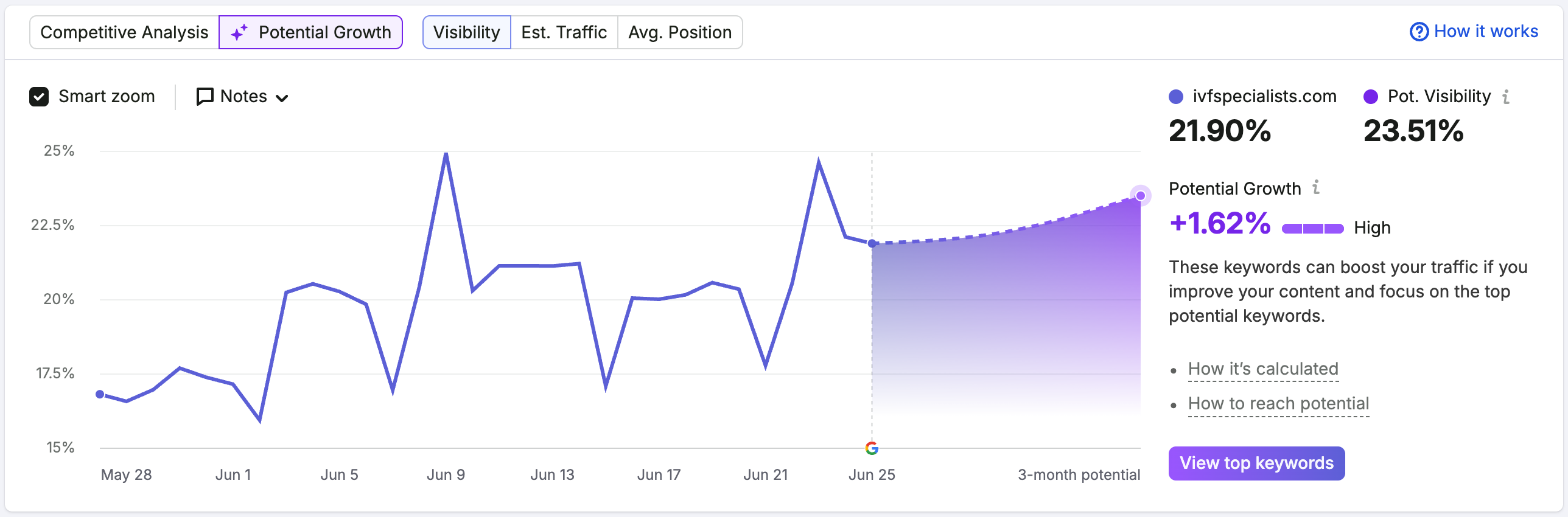 Semrush's "Potential Growth" metrics give you a detailed plan for boosting traffic. | Semrush
Automated Marketing Analytics Tools
Automated marketing analytics tools help reduce manual reporting work.
Instead of pulling data from multiple platforms every week or month, teams can create dashboards, reports, and alerts that update automatically.
Automation can help with:
- recurring performance reports
- dashboard updates
- anomaly alerts
- campaign pacing reports
- lead source reporting
- channel comparisons
- CRM reporting
- executive summaries
- client reporting
The best automated marketing analytics tools do not just save time. They make performance easier to understand.
Custom SEO dashboards can be easy to set up and useful for monitoring search visibility, content performance, and conversion trends without rebuilding reports manually each month.
Automated reporting is especially useful for teams implementing multichannel marketing strategies, so they can accurately compare their ROI for SEO, paid media, email, social, and content campaigns.
But automation should not remove interpretation. A dashboard can show what changed. A marketing team still needs to explain why it changed and what to do next.
What Healthcare Marketers Expect From Analytics Tools
Healthcare marketers often have more complex analytics needs because they must balance performance, privacy, trust, and patient journey complexity.
Healthcare marketing analytics tools often need to support:
- appointment request tracking
- call tracking
- service-line performance
- location-level reporting
- campaign attribution
- patient journey analysis
- HIPAA-aware workflows
- reputation and review visibility
- local search performance
- lead quality measurement
Healthcare teams may also need analytics tools that help compare performance across providers, service lines, locations, and campaigns.
The most useful tools for healthcare marketers are not just the ones that produce more reports. They are the ones that help teams understand which marketing efforts are generating meaningful, compliant, and measurable patient engagement.
Choosing the Right Marketing Analytics Platform
The best digital marketing analytics tools depend on your organization’s size, goals, channels, reporting needs, and internal capacity.
A small business may start with Google Analytics, Search Console, Looker Studio, and a CRM.
A growing B2B company may need HubSpot, Google Ads reporting, call tracking, SEO tools, and custom dashboards.
An enterprise organization may need Adobe Analytics, Tableau, data warehouses, predictive analytics, and advanced governance.
Before choosing tools for marketing analytics, ask:
- What decisions do we need this data to support?
- Which channels matter most?
- What conversions need to be tracked?
- Do we need CRM attribution?
- Do we need automated dashboards?
- Do we need predictive analytics?
- Who will maintain the data?
- Who will interpret the reports?
- How will insights influence budget decisions?
The right tools are the ones teams can use consistently to make better decisions.
Marketing Analytics vs. SEO and AEO Tools
Marketing analytics tools help measure campaign performance across channels, but they serve a different purpose than SEO and Answer Engine Optimization tools.
SEO and AEO tools focus on search visibility, content optimization, rankings, brand mentions, citations, and AI-driven discovery. Pairing these with web analytics platforms provides a more complete view of digital marketing campaign performance.
SEO and AEO tools show how people discover your brand in search and AI environments. Analytics tools show how users behave and convert.
How Advanced Marketing Analytics Tools Improve Decision-Making
Advanced marketing analytics tools improve decision-making by helping teams move from assumptions to evidence.
Instead of guessing which campaigns are working, marketers can compare performance across channels, audiences, content, landing pages, and conversion paths.
Strong analytics tools help teams answer questions like:
- Which campaigns generate the highest-quality leads?
- Which channels contribute most to revenue?
- Which content supports conversions?
- Which audiences are most engaged?
- Which landing pages need improvement?
- Which campaigns should receive more budget?
- Which marketing activities are not producing enough return?
Better analytics gives teams the visibility they need to make stronger decisions.
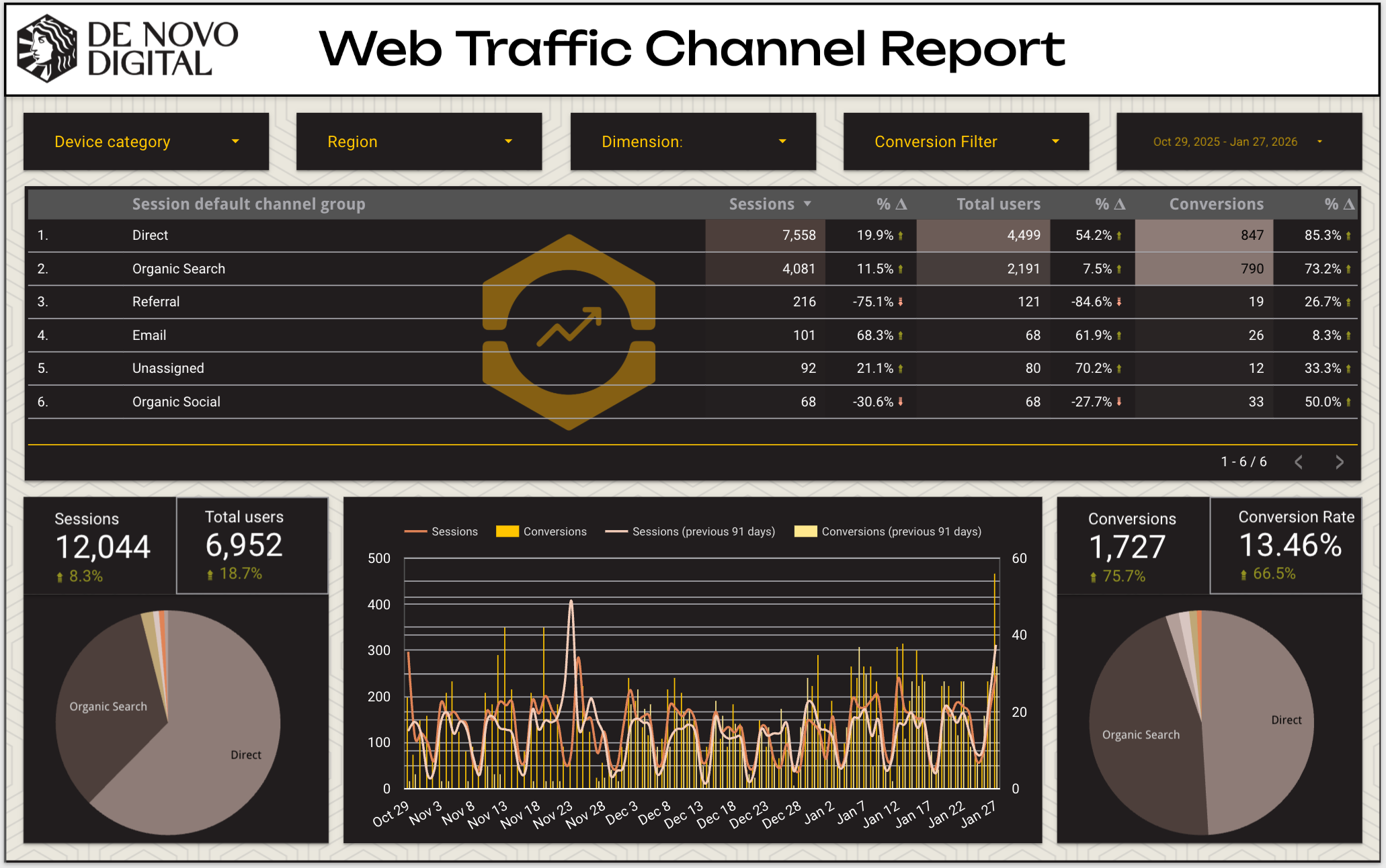
 A sample ROI-focused dashboard from our free HubSpot Conversion Tracking Guide.
Connecting Marketing Analytics to Business Growth
The ultimate goal of marketing measurement is understanding how marketing contributes to real business outcomes.
Organizations that connect marketing analytics with business objectives gain a clearer view of performance. They can demonstrate ROI, justify investments, identify weak points, and find better opportunities for growth.
A digital marketing audit can help businesses evaluate whether their website, content, SEO, paid media, analytics, CRM, and conversion tracking are working together or operating in silos.
For many teams, analytics becomes most valuable when it reveals where the system is breaking.
Turning Marketing Data Into Strategic Insight
Marketing analytics tools provide information. Strategy turns that information into action.
The most successful marketing teams treat analytics as a continuous feedback loop.
Campaign performance informs strategy. Strategy shapes testing. Testing creates new insights. Those insights improve future campaigns.
When analytics, strategy, and experimentation work together toward conversion rate optimization, teams can improve the user journey instead of simply reporting traffic, making marketing more predictable and scalable.
This is especially important as AI tools, automated dashboards, predictive analytics, and multichannel reporting become more common.
The advantage will not go to the team with the most data.
It will go to the team that knows how to use it.
Want to Improve Your Marketing Performance?
Marketing analytics is only one part of a stronger digital marketing system.
Businesses seeking better performance often begin by evaluating their website, search visibility, content strategy, campaign tracking, and conversion paths.
At De Novo Digital, we help organizations build clearer marketing measurement systems using analytics tools, dashboards, SEO reporting, CRM data, campaign tracking, and performance strategy.
Our SEO audit services help organizations identify technical issues, competitive gaps, content opportunities, and growth barriers across their digital presence.
If your team has plenty of data but not enough clarity, we can help you turn reporting into better decisions.
Connect with us today to learn more about how to improve your marketing analytics.