


Sustainable mass tort lead generation is built around speed, compliance, and intake performance
Mass tort marketing is defined by its scale, but volume isn't everything.
It moves faster. It costs more. It requires tighter intake. It depends on case criteria that can change quickly. And the difference between a profitable campaign and a wasted budget often comes down to how well a firm can identify, qualify, and sign the right plaintiffs before competitors do.
For plaintiff firms, it can be easy to mistake mass tort lead generation for a pure volume play, but a strategy rooted in volume will quickly outgrow itself.
A more sustainable system turns interest into qualified, signed cases while protecting the firm’s budget, reputation, and long-term litigation strategy.
That is why the best mass tort marketing strategies connect media buying, content, landing pages, intake, automation, lead scoring, compliance, and reporting into one coordinated process.
What Is Mass Tort Marketing?
Mass tort marketing is the process of identifying and reaching potential plaintiffs who may have claims related to a large-scale injury, defective product, dangerous drug, environmental exposure, data breach, or other widespread harm.
Unlike standard personal injury marketing, mass tort attorney marketing often focuses on specific litigation opportunities with defined eligibility criteria.
A campaign may target people who:
- used a specific product
- took a specific medication
- received a specific implant or device
- lived or worked near a contaminated site
- experienced a qualifying injury
- meet exposure, date, geography, diagnosis, or documentation requirements
Because mass tort cases often involve high competition and complex eligibility criteria, marketing cannot stop at generating inquiries.
This is why mass tort campaigns should connect closely with broader lead generation systems, especially when firms need to track both inquiry volume and signed-case quality.
The focus should always be to generate qualified claimants who can move through intake, screening, documentation, and retainer execution efficiently.
What Is MDL Lead Generation?
MDL lead generation focuses on finding potential plaintiffs for cases that are part of multidistrict litigation.
In an MDL, related lawsuits are centralized in one federal court for pretrial proceedings. That structure can create major opportunities for plaintiff firms, but it also creates pressure.
Firms may need to move quickly when a litigation trend emerges, when new science becomes available, when a filing deadline approaches, or when competition for qualified claimants increases.
MDL lead generation usually requires:
- litigation-specific messaging
- rapid campaign deployment
- strict qualification criteria
- high-volume intake capacity
- fast follow-up
- medical record or documentation review
- lead source tracking
- retainer workflow management
- compliance oversight
A general legal lead generation campaign is rarely enough.
MDL marketing services need to support both acquisition and intake quality.
Why Mass Tort Lead Generation Is Different
Mass tort lead generation is different because the economics are different.
A standard legal lead may be evaluated based on contact information and general interest. A mass tort lead must be evaluated against case-specific criteria that may determine whether the inquiry is valuable or unusable.
That makes qualification critical.
A strong mass tort campaign should consider:
- exposure or product use
- injury or diagnosis
- timeline
- geography
- statute or filing deadlines
- medical documentation
- prior representation
- claimant responsiveness
- strength of evidence
- litigation stage
- expected cost per signed case
Lead volume alone can be misleading.
A campaign that produces thousands of low-quality inquiries may create more intake burden than value. A smaller campaign that produces fewer but stronger claimants may be more profitable and easier to manage.
In mass tort marketing, the quality of the intake system matters as much as the quality of the ad campaign.
The Core Pieces of a Strong Mass Tort Marketing System
Mass tort marketing works best when every part of the system is built around speed, clarity, and qualification.
A strong system usually includes the following pieces.
Clear Case Criteria
Before launching a campaign, the firm needs clear claimant criteria.
This includes who qualifies, who does not qualify, what documentation is needed, what injuries or diagnoses matter, and what dates or exposure windows apply.
Without clear criteria, intake teams may waste time on leads that were never viable.
Compliant Messaging
Mass tort advertising must be accurate, ethical, and easy to understand.
Campaign messaging should explain the potential issue, who may qualify, and what next step someone can take without overstating outcomes or creating unrealistic expectations.
Clear messaging can improve both lead quality and claimant trust.
Dedicated Landing Pages
Mass tort campaigns need landing pages designed for specific litigation. A good landing page should explain the case clearly, list basic eligibility factors, answer common questions, and make it easy to request a case review.
The page should also avoid unnecessary friction. If a potential claimant is confused, skeptical, or overwhelmed, they may leave before completing the form.
The page experience matters, too. Custom law firm web design can help ensure campaign traffic has a clear, credible path from interest to inquiry.
Fast Intake
Speed matters.
Potential plaintiffs often submit multiple inquiries when they are trying to understand whether they have a case. If your firm or intake partner waits too long to respond, another firm may sign the claimant first.
Fast intake requires the systems, staffing, scripts, and workflows needed to respond quickly and qualify intelligently.
Lead Scoring and Qualification
Not every lead deserves the same follow-up priority.
Lead scoring can help firms identify which inquiries appear strongest based on case criteria, documentation, responsiveness, and claimant fit.
This overlaps with conversion rate optimization, because the goal is not only to generate traffic – it is to improve the path from inquiry to qualified case review.
Retainer Workflow
A mass tort campaign is not successful until qualified claimants move through the required next steps.
That may include follow-up calls, document collection, medical authorization forms, retainer execution, and case management system updates.
Weak retainer workflows can waste strong leads.
Reporting and Attribution
Mass tort marketing needs clear reporting.
Firms should know which campaigns, channels, messages, landing pages, and lead sources are producing qualified inquiries, signed retainers, and viable cases.
Without attribution, it becomes difficult to understand whether a campaign is actually profitable.

If your mass tort marketing system isn't focused on lead quality, intake capacity, and signed-case volume, it isn't sustainable.
Mass Tort Marketing Channels
Mass tort marketing can use several channels, but the best mix depends on the case, timeline, budget, audience, and competition.
Paid Search
Paid search can capture people actively looking for information about a specific case, injury, drug, device, or settlement. It is often high-intent, but it can also become expensive quickly when multiple firms are bidding on the same terms.
Paid search works best when landing pages, call tracking, form tracking, and intake workflows are tightly connected.
For firms investing heavily in search and social campaigns, coordinated paid media services can help align targeting, creative, landing pages, and reporting.
Paid Social
Paid social can help reach broader audiences who may not know they have a potential claim. This can be useful for awareness, education, and targeting groups based on interests, demographics, geography, or behavior.
Because paid social may generate earlier-stage interest, qualification and intake are especially important.
SEO and Content
SEO can support mass tort marketing by helping firms build organic visibility around litigation-related questions. Content may answer questions about symptoms, exposure, eligibility, documentation, deadlines, and next steps.
Strong organic visibility also depends on the same fundamentals that support SEO for lawyers, including helpful content, technical structure, authority, trust signals, and clear calls to action.
This is especially useful for firms that want to reduce reliance on paid lead sources over time.
Email and Retargeting
Email and retargeting can help re-engage people who started but did not complete the intake process. These channels can also support document collection, follow-up reminders, and education.
For legal campaigns, retargeting and email need careful compliance review.
Referral and Co-Counsel Networks
Some firms generate mass tort cases through referral relationships, co-counsel networks, community connections, and professional partnerships.
These channels may produce fewer leads than large media campaigns, but they can produce high-quality claimants when relationships are strong.
AI Search and Answer Engines
AI search is becoming more important as people ask tools like ChatGPT, Perplexity, Google AI, and Bing Copilot questions about injuries, products, lawsuits, eligibility, and legal options.
Mass tort firms need content that is clear, accurate, structured, and easy for AI systems to understand. That means building useful resources that answer real claimant questions and demonstrate legal credibility.
Tracking AI search metrics can help firms understand whether their content is being surfaced, cited, or summarized across answer-driven search environments.
Why Intake Is the Bottleneck
Mass tort campaigns rely on fast response times to sign more plaintiffs. They fail when the intake system cannot handle the opportunity.
Intake bottlenecks can appear when:
- calls are missed
- response times are slow
- forms are too long
- qualification questions are unclear
- staff are not trained on case criteria
- documentation requests are delayed
- follow-up is inconsistent
- leads are not prioritized
- CRM stages are messy
- reporting is incomplete
- retainers are not sent quickly enough
Mass tort lead generation only works when intake is built for speed and scale. If a firm spends heavily on media but cannot contact, qualify, and sign claimants quickly, the campaign economics can break down.
How AI Can Improve Mass Tort Intake
AI can help mass tort intake teams respond faster, screen more consistently, and identify stronger cases earlier.
AI can support:
- lead triage
- qualification workflows
- call summaries
- document review
- medical record sorting
- intake scripting
- follow-up reminders
- eligibility scoring
- duplicate detection
- reporting summaries
While AI can’t replace legal judgment or human empathy, it can help intake teams manage volume, reduce repetitive work, and identify which leads require faster attention.
For mass tort firms, the practical value of AI is reducing the gap between inquiry and qualified case review.
Building a Better MDL Marketing Strategy
A strong MDL marketing strategy should begin before the campaign launches.
Start with the case criteria, campaign economics, intake plan, compliance review, reporting setup, and follow-up workflow.
Then build the media plan.
Too many firms start with ad spend and try to fix intake later. In mass torts, that can become expensive quickly.
Compliance in Mass Tort Attorney Marketing
Mass tort attorney marketing must be handled carefully.
Campaigns should be reviewed for accuracy, ethics, disclaimers, jurisdictional issues, testimonial use, outcome claims, referral arrangements, and state bar rules. Firms should also evaluate whether third-party mass tort marketing firms, lead vendors, and intake partners are following appropriate standards.
Compliance should be built into the campaign before launch, not reviewed after problems appear.
A sustainable mass tort marketing system should document:
- ad copy approvals
- landing page approvals
- intake scripts
- disclaimers
- lead source records
- consent language
- referral terms
- vendor responsibilities
- reporting definitions
Marketing speed matters, but not at the expense of trust.
How to Evaluate Mass Tort Marketing Firms
Many firms search for mass tort marketing firms, mass tort marketing agencies, MDL marketing services, or the best mass tort lead generation companies when they want to scale a docket.
The right partner should be evaluated on more than lead volume.
Before choosing a mass tort marketing agency, ask:
- How are leads generated?
- Are leads exclusive or shared?
- What qualification criteria are used?
- How quickly are leads contacted?
- What intake support is included?
- How is consent documented?
- How are duplicate leads handled?
- What reporting is provided?
- Can the partner track cost per signed case?
- How are campaigns reviewed for compliance?
- What happens when criteria change?
- How are underperforming channels optimized?
The best mass tort lead generation partners should help the firm understand cost, quality, speed, and signed-case economics. A higher cost per lead may be acceptable if the signed-case rate, documentation quality, and case viability are stronger.
Metrics That Matter in Mass Tort Lead Generation
Mass tort marketing should be measured beyond lead count.
Useful metrics include:
- cost per lead
- cost per qualified lead
- cost per signed retainer
- contact rate
- speed to first contact
- qualification rate
- retainer completion rate
- documentation completion rate
- duplicate rate
- source quality
- channel performance
- intake response time
- lead-to-signed-case conversion rate
- disqualification reasons
- campaign profitability
The most important metric is the cost to acquire a signed, qualified, viable case. That requires close alignment between marketing, intake, operations, and litigation strategy.
Firms using HubSpot conversion tracking or similar CRM reporting can connect campaign sources to intake outcomes, signed retainers, and downstream case quality.
Free Guide
The HubSpot Conversion Tracking Blueprint
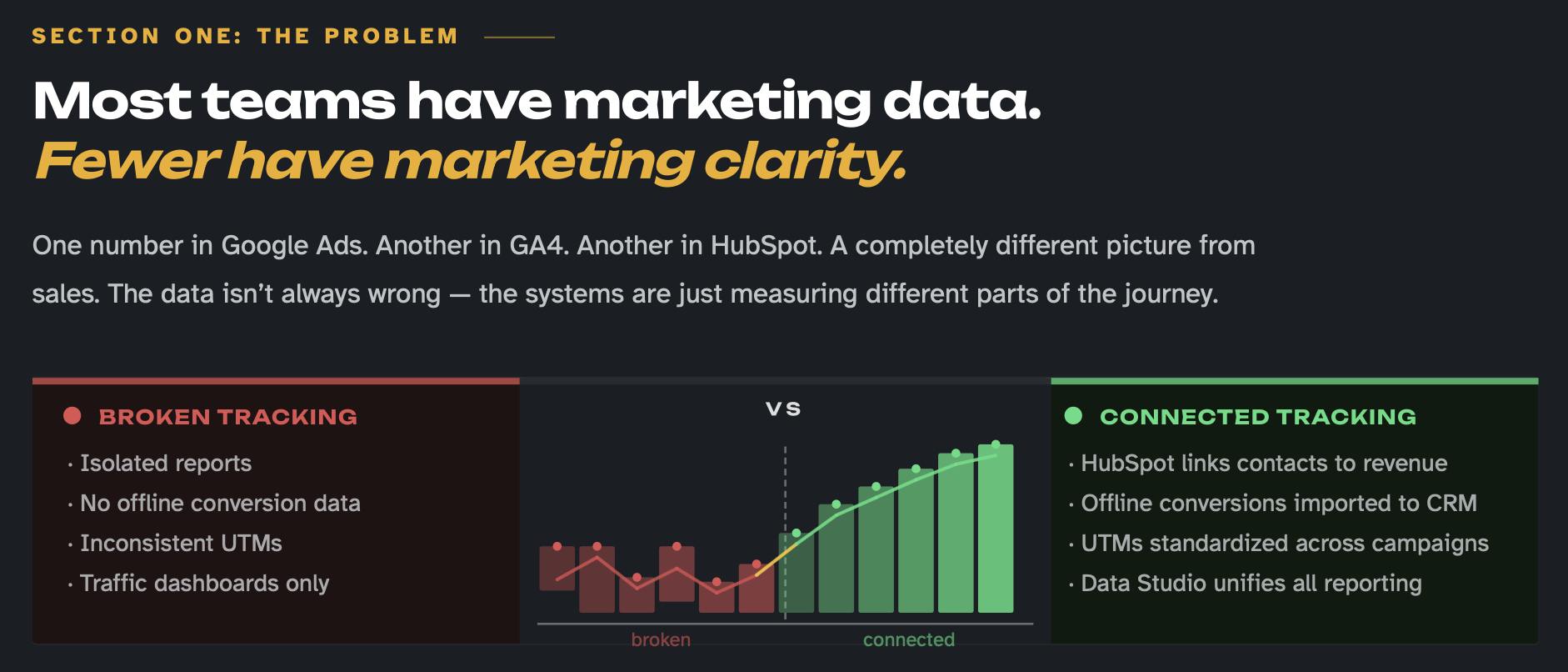
Learn how to measure leads, campaigns, attribution, and ROI across every marketing channel — with HubSpot as your central source of truth. Covers GTM, GA4, Google Ads, Data Studio, lifecycle stages, and dashboard clarity.
The Future of Mass Tort Marketing
Mass tort marketing is becoming more competitive, more data-driven, and more closely tied to intake technology. The firms that win will not simply be the firms with the largest budgets.
They will be the firms that can:
- identify opportunities early
- launch campaigns quickly
- qualify leads accurately
- respond immediately
- use AI responsibly
- track campaign economics
- maintain compliance
- build trust with claimants
- improve intake continuously
Mass tort marketing will always require volume, but the future belongs to firms that can combine reach with precision.
Master MDL Lead Generation With a Better System
Mass tort marketing works best when campaigns are built around qualified cases, not just inquiries. That requires strong messaging, careful compliance, fast intake, clear eligibility criteria, smart attribution, and a marketing system that can adapt as the litigation changes.
At De Novo Digital, we help law firms build digital marketing strategies that support visibility, lead generation, intake performance, and measurable growth. From legal SEO and paid media to landing pages, analytics, campaign tracking, and AI search visibility, we help firms create marketing systems designed for performance.
If your firm needs a stronger approach to mass tort marketing or MDL lead generation, we can help you build a strategy that turns campaign activity into qualified opportunities.
Get in touch today to learn more about our mass tort marketing services.